Between-Session Reliability of GPS Technology for Quantifying Linear and Curvilinear Base-Running Performance
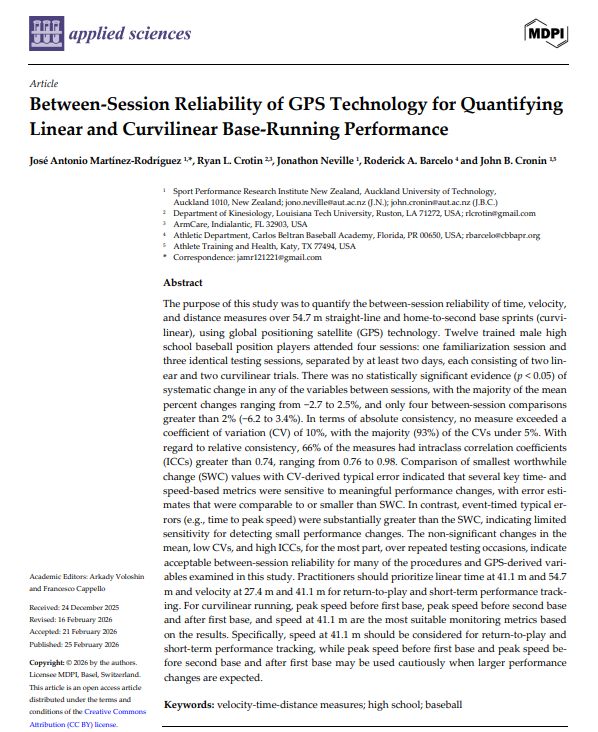
The purpose of this study was to quantify the between-session reliability of time, velocity, and distance measures over 54.7 m straight-line and home-to-second base sprints (curvilinear), using global positioning satellite (GPS) technology. Twelve trained male high school baseball position players attended four sessions one familiarization session and three identical testing sessions, separated by at least two days, each consisting of two linear and two curvilinear trials. There was no statistically significant evidence (p < 0.05) of systematic change in any of the variables between sessions, with the majority of the mean percent changes ranging from −2.7 to 2.5%, and only four between-session comparisons greater than 2% (−6.2 to 3.4%). In terms of absolute consistency, no measure exceeded a coefficient of variation (CV) of 10%, with the majority (93%) of the CVs under 5%. With regard to relative consistency, 66% of the measures had intraclass correlation coefficients (ICCs) greater than 0.74, ranging from 0.76 to 0.98. Comparison of smallest worthwhile change (SWC) values with CV-derived typical error indicated that several key time- and speed-based metrics were sensitive to meaningful performance changes, with error estimates that were comparable to or smaller than SWC. In contrast, event-timed typical errors (e.g., time to peak speed) were substantially greater than the SWC, indicating limited sensitivity for detecting small performance changes. The non-significant changes in the mean, low CVs, and high ICCs, for the most part, over repeated testing occasions, indicate acceptable between-session reliability for many of the procedures and GPS-derived variables examined in this study. Practitioners should prioritize linear time at 41.1 m and 54.7 m and velocity at 27.4 m and 41.1 m for return-to-play and short-term performance tracking. For curvilinear running, peak speed before first base, peak speed before second base and after first base, and speed at 41.1 m are the most suitable monitoring metrics based on the results. Specifically, speed at 41.1 m should be considered for return-to-play and short-term performance tracking, while peak speed before first base and peak speed before second base and after first base may be used cautiously when larger performance changes are expected.
Context
The first peer-reviewed scientific publication emerging from the Carlos Beltran Baseball Academy—an institution inspired by the standards of a Hall of Famer—marks a decisive step forward in Sport Science by placing Base Running Science at the forefront of evidence-based baseball performance.
This peer-reviewed investigation, published in Applied Sciences (2026), evaluated the between-session reliability of 10 Hz GPS technology for quantifying linear (home-to-first) and curvilinear (home-to-second) base-running performance over 54.7 m in trained high school baseball athletes
The study applied a repeated-measures design across three sessions and examined systematic change, absolute reliability (coefficient of variation, CV), relative reliability (intraclass correlation coefficient, ICC), and practical sensitivity via smallest worthwhile change (SWC).
Key findings of direct relevance to baseball performance departments include:
1, No statistically significant systematic bias across sessions for linear or curvilinear metrics.
High absolute reliability, with all CVs <10% and 93% <5%, meeting accepted sport science thresholds for monitoring.
Strong relative reliability for most time- and speed-based metrics (ICCs frequently >0.75, many >0.90).
Practically sensitive metrics (TE ≤ SWC) included:
Linear sprint: time to 41.1 m and 54.7 m; velocity at 27.4 m and 41.1 m.
Curvilinear sprint: speed at 41.1 m; peak speed before first base; peak speed before second base and after first base.
Importantly, the study advanced beyond traditional timing gates by quantifying velocity-time-distance signatures across true game-specific curvilinear paths (home-to-second), including acceleration, modulation entering first base, and re-acceleration phases. For MLB organizations and performance shareholders, this provides validated, baseball-specific monitoring variables capable of informing return-to-play decisions, longitudinal talent tracking, workload management, and individualized base-running prescriptions.
Objectively, this article represents a structural advancement in base-running research for three reasons:
First Reliability Framework for True Baseball Curvilinear Running: Prior GPS reliability work largely examined soccer or track-based semi-circular protocols. This study uniquely validated GPS metrics using the authentic home-to-second base trajectory, directly reflecting in-game mechanics
Integration of Reliability with Practical Sensitivity (SWC vs. TE): By formally comparing typical error against smallest worthwhile change, the paper moves the field from descriptive measurement toward decision-making science—critical for MLB high-performance departments.
Establishment of Monitoring Benchmarks: The identification of specific robust metrics (e.g., speed at 41.1 m in both linear and curvilinear contexts) provides the first evidence-based recommendation set tailored specifically to baseball base running.
Within the broader sport science ecosystem, base running has historically been under-quantified relative to pitching biomechanics and hitting analytics. This publication elevates base running from observational coaching practice to a quantifiable performance domain with validated measurement parameters. As a result, it positions Base Running Science as a legitimate sub-discipline within applied baseball performance research.
For the Carlos Beltran Baseball Academy, this work does more than contribute data—it establishes institutional credibility in peer-reviewed sport science, signaling a transition from development academy to research-driven performance leader.
Where it’s published: